
Indonesia kratom export is now far more regulated than it was a few years ago. Indonesia is one of the world’s main sources of kratom, but since 2024, exports follow written rules, require licences, and are subject to government-set export rights. For importers, understanding how this system developed explains why export documents, particle size, and laboratory testing matter in every order.
This article summarises the main steps. It is general information, not legal advice, and regulations can change, so always check the original documents before making business decisions.
A Domestic Restriction, An Export Channel
Inside Indonesia, kratom has been restricted since 2016, when the national food and drug authority (BPOM) banned its use in traditional medicines and health supplements. The Trade Minister has also stated that no rules yet exist for buying and selling kratom domestically, while export is permitted under specific procedures. This split is the starting point for the export system that followed.
September 2024: Two Regulations Create an Indonesia Kratom Export Framework
In September 2024, the government issued Trade Ministerial Regulations No. 20 and No. 21 of 2024. Together they defined what may and may not be exported:
- Whole kratom leaves and crumbs larger than 600 microns are prohibited from export.
- Powder and crumbs of 600 microns or less may be exported under regulation.
- Exporters must be a Registered Exporter (ET), obtain an Export Approval (PE), and hold a Surveyor Report (LS).
- Reports at the time also said exports must meet standard requirements, including freedom from microbiological contamination, heavy metals, and other leaf mixtures.
This is why export-grade kratom is typically offered as fine powder rather than raw leaf.
February 2025: The First Official Shipment
On 28 February 2025, the Trade Minister sent off 13 containers of kratom products from an Indonesian exporter to the United States and Europe. The shipment weighed 351 tons and was valued at about US$1.053 million. The occasion was presented as the first official export release under the new framework.
2025 and 2026: Export Rights and Quotas
The Trade Ministry also sets an export-rights percentage for kratom, applied to production capacity, one half-year at a time. Two decisions cover 2026:
- Ministerial Decision No. 32 of 2026, set on 13 January 2026, for January to June 2026.
- Ministerial Decision No. 1522 of 2026, signed on 30 June 2026, for July to December 2026.
The exact percentages are published in each decision. Check the Trade Ministry’s legal database (JDIH) for the current figures.
March to April 2026: Licensing Updated
On 17 March 2026, Indonesia issued two Trade Ministry regulations updating the export licensing system. Both took effect on 1 April 2026. They digitalise the licensing process through the INATRADE platform, which is integrated with the national single window (INSW). One report on the changes also noted that Registered Exporter status for kratom now has a three-year validity period instead of lifetime validity.
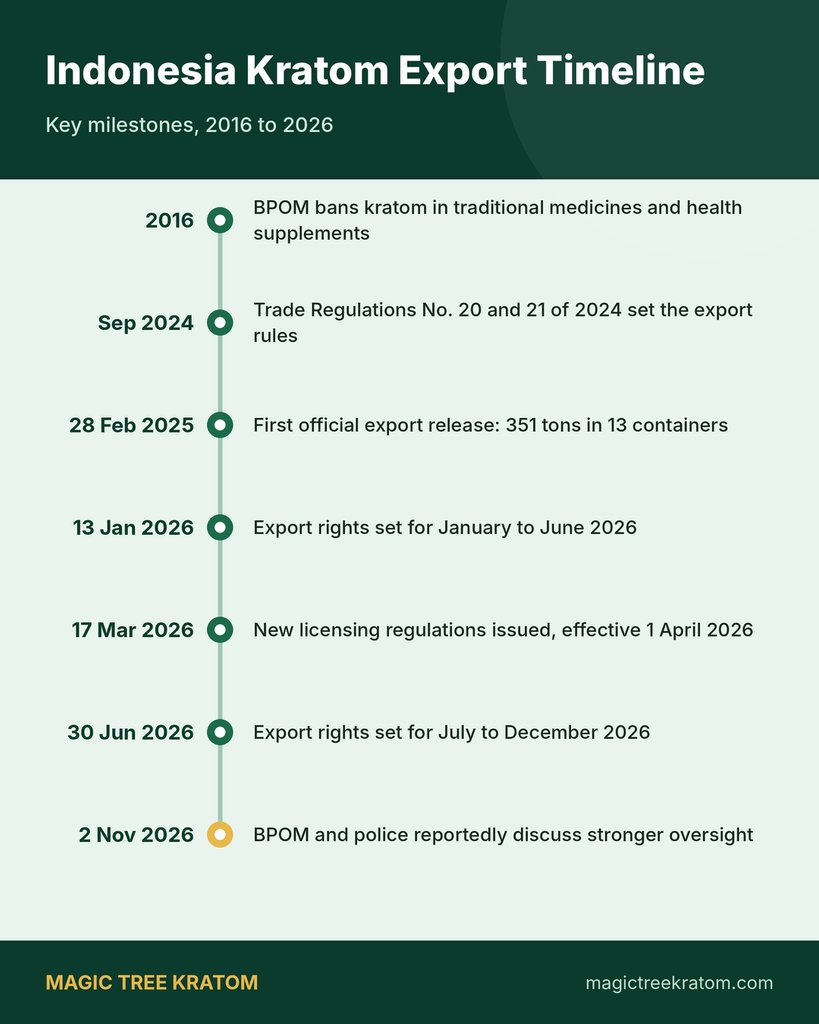
| Date | Milestone |
|---|---|
| 2016 | BPOM bans kratom in traditional medicines and health supplements |
| September 2024 | Trade Ministerial Regulations No. 20 and 21 of 2024 set export rules |
| 28 February 2025 | First official export release: 351 tons, 13 containers |
| 13 January 2026 | Export rights set for January to June 2026 (Decision No. 32/2026) |
| 17 March 2026 | New export licensing regulations issued, effective 1 April 2026 |
| 30 June 2026 | Export rights set for July to December 2026 (Decision No. 1522/2026) |
| 2 November 2026 | BPOM and the national police reportedly discuss stronger kratom oversight |
What This Means for Importers
- Ask about licensing. Confirm that your supplier is a Registered Exporter and can explain the export documents involved (ET, PE, and LS).
- Check the particle size. Export-grade kratom is powder or fine crumbs of 600 microns or less. Specify this in your purchase order.
- Plan ahead. Because export rights are set per period, availability and lead times can be affected. Discuss timing with your supplier early.
- Request testing. Ask which laboratory tests accompany your shipment and how to read them. Our COA checklist for importers (tautkan ke artikel How to Read a Kratom COA) explains what to look for.
- Check your own market. Indonesian export rules do not replace the import rules of your destination country.
What Is Still Changing
The domestic side of kratom regulation is still developing. Media reported that BPOM and the national police met on 2 November 2026 to discuss stronger oversight. Importers should expect the rules around Indonesia kratom export to keep evolving and should check for updates regularly.
Conclusion
In little more than two years, Indonesian kratom exports moved from an unclear situation to a licensed system with defined products, documents, and export rights. For buyers, the practical lesson is to work with suppliers who understand this framework and can document their products clearly.
At Magic Tree Kratom, we are happy to discuss Indonesia kratom export documents, specifications, and testing for your orders. See our Lab Result page or Contact our team to talk about your requirements.
Sources
- Trade Ministerial Regulations No. 20 and 21 of 2024, summarised by Niaga.Asia and Tempo (9 September 2024)
- ANTARA, report on the 28 February 2025 export release of 351 tons
- Ministry of Trade (Kemendag), statement by the Trade Minister on domestic and export rules
- JDIH Kemendag, Ministerial Decisions No. 32/2026 and No. 1522/2026 on kratom export rights
- Assegaf Hamzah and Partners client update (27 April 2026) and Petromindo, on the March 2026 export licensing regulations
- BPOM kratom ban since 2016, as reported by UKM Indonesia and Seasia
- Receh.in report on the BPOM and police meeting (2 November 2026)