
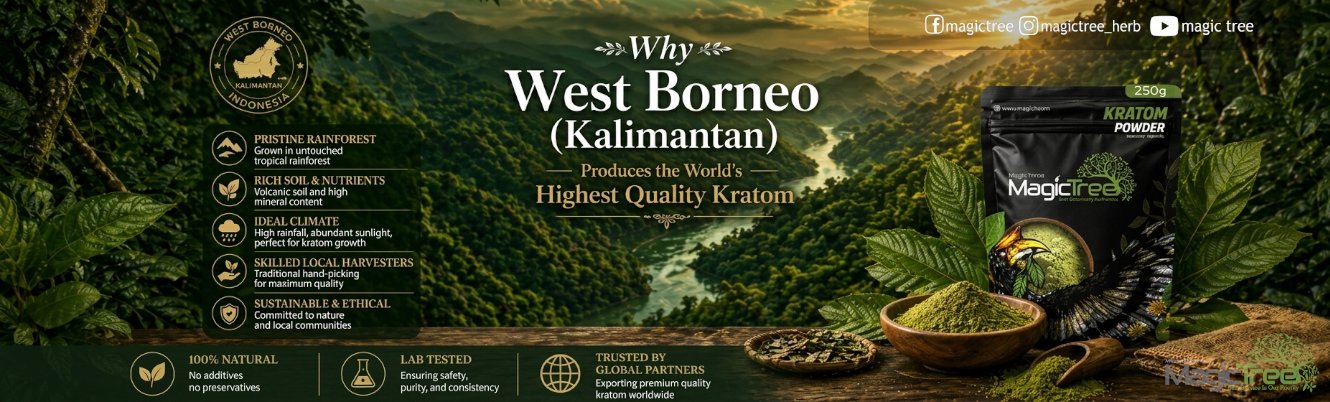
If you’ve spent more than five minutes researching kratom online, you’ve probably noticed a recurring theme: West Borneo (Kalimantan). Whether it’s Red Maeng Da, Super Green Malay, or White Jongkong, almost every premium strain traces its roots back to this specific slice of Indonesia.
But why? Is it just clever marketing by Indonesian exporters, or is there some actual “magic” in the soil? As it turns out, the reputation of West Borneo kratom isn’t just hype—it’s the result of a perfect storm of geography, ancient biology, and traditional harvesting techniques.
Let’s dive into why this region remains the undisputed heavyweight champion of the kratom world.
The Geography of Potency: Why West Borneo is the Perfect Cradle
To understand the quality of kratom (Mitragyna speciosa), you first have to understand the tree itself. Kratom is a tropical evergreen tree in the coffee family. Like a fine wine grape, the chemistry of the leaf is dictated by its environment—a concept known in the culinary world as terroir.
The Tropical Greenhouse Effect
West Kalimantan (Kalimantan Barat) sits right on the equator. This means the trees receive consistent, intense sunlight year-round. However, it’s not just the sun; it’s the rain. The region experiences heavy tropical downpours that keep the soil saturated and the humidity levels sky-high.
Kratom trees thrive in these “swampy” conditions. High humidity forces the tree to produce more alkaloids as a defense mechanism against local pests and fungi. In West Borneo, the trees aren’t just surviving; they are in their natural, high-stress-but-high-growth element, which maximizes the production of Mitragynine and 7-hydroxymitragynine.
Ancient Soil and Mineral Richness
The soil in West Borneo, particularly around the Kapuas River basin, is incredibly nutrient-dense. This isn’t your standard backyard dirt; it’s a complex mix of volcanic minerals and centuries of decomposed organic matter from the rainforest floor. This rich “black soil” provides the trees with the nitrogen and minerals necessary to develop thick, alkaloid-heavy leaves.
The Role of the Kapuas River: The Lifeline of Quality Kratom
If West Borneo is the heart of the kratom industry, the Kapuas River is its primary artery. Stretching over 1,100 kilometers, it is the longest river in Indonesia.
Read also: Kratom for Beginners: Top 5 Tips for Choosing Your First Strain Safely
Periodic Flooding and Nutrient Cycles
The areas surrounding the Kapuas River are prone to seasonal flooding. While this might be a headache for urban planners, it’s a blessing for kratom quality. When the river overflows, it deposits fresh silt and minerals onto the banks where many wild kratom trees grow. This natural fertilization process ensures that the trees have a constant “superfood” supply, leading to the world’s highest quality kratom with consistent potency.
Wild-Grown vs. Plantation
A significant portion of West Borneo’s kratom is “Wild Crafted.” Instead of being grown in neat rows on a farm, many harvesters trek deep into the jungle or travel by boat along the Kapuas to harvest from ancient, towering trees. These older trees have deeper root systems and have had decades to develop complex alkaloid profiles that young plantation trees simply can’t match.
Genetic Diversity: The Secret Behind Different Strains
One of the biggest reasons West Borneo dominates the market is the sheer variety of trees found there. You might hear terms like Hulu, Jongkong, or Pontianak. These aren’t just brand names; they are geographical markers within West Kalimantan.
- Hulu Kapuas: Refers to kratom from the “headwaters” or upper regions of the river. This area is remote and pristine, producing leaves known for high energy and potency.
- Jongkong: A specific region in the Kapuas Hulu Regency known for producing leaves with a very high alkaloid content, often used for “Super” strains.
- Malay Strains in Borneo: Interestingly, many “Malay” strains are actually grown in the border regions of West Kalimantan. The genetic stock is similar, but the Borneo soil gives them an extra “kick.”
The genetic diversity in the West Borneo jungles allows farmers to find specific “mother trees” with unique properties, ensuring that whether you want relaxation or focus, the region has a specific tree for that.
Traditional Harvesting and Drying: The “West Borneo Way”
The quality of kratom isn’t just about how it grows; it’s about how it’s handled after it leaves the branch. The farmers in West Kalimantan have been refining their drying techniques for generations.
The Art of Fermentation
Ever wonder how Red Vein Kratom gets its deep color and soothing properties? It’s often through a fermentation process. Farmers in West Borneo place harvested leaves in bags to trap moisture, allowing a slight fermentation that alters the alkaloid profile, converting some Mitragynine into 7-hydroxymitragynine.
Climate-Controlled Indoor Drying
While many other regions sun-dry their leaves (which can bleach the chlorophyll and degrade alkaloids), the top-tier producers in West Borneo utilize indoor drying barns. By controlling the airflow and light exposure, they preserve the vibrant green color and protect the delicate chemical compounds from UV damage. This attention to detail is why West Borneo kratom often looks and smells fresher than products from other regions.
Sustainability and Local Expertise
The people of West Kalimantan don’t just see kratom as a commodity; for many, it’s a way of life and a primary source of income that protects the rainforest. Because kratom is a tree crop, it encourages the preservation of the jungle rather than clearing it for palm oil plantations.
Selective Harvesting
Experienced local harvesters know exactly which leaves to pick. They don’t strip the tree bare. They select the mature, large leaves that have reached peak alkaloid density. This “selective harvesting” ensures the tree remains healthy and continues to produce high-quality foliage for years to come.
Why “Maeng Da” Found Its Home in West Borneo
Although “Maeng Da” is a Thai term meaning “Pimp Grade,” the vast majority of modern Maeng Da is sourced from West Borneo. Local farmers took the concept of “the strongest of the batch” and applied it to their most potent trees. Through clever grafting and selection of the spikiest, most alkaloid-rich leaves, West Borneo has become the global hub for authentic, high-potency Maeng Da.
Summary: The West Borneo Gold Standard
When you buy kratom from West Borneo, you aren’t just buying a crushed leaf; you are buying a product of:
- Equatorial Sunlight that fuels rapid growth.
- Volcanic, Mineral-Rich Soil that feeds the roots.
- The Kapuas River Ecosystem that provides natural irrigation.
- Generational Knowledge regarding drying and fermentation.
In the world of botanicals, environment is everything. Just as the best coffee comes from the Ethiopian highlands or the best cigars from the Vuelta Abajo in Cuba, the highest quality kratom in the world belongs to West Borneo (Kalimantan).
If you are looking for consistency, potency, and purity, there simply is no substitute for the ancient jungles of the Kapuas region. It’s nature’s own laboratory, and it’s been perfecting the kratom tree for thousands of years.
1 Trackback
Sustainable Harvesting: Preserving the Rainforest and Supporting Local Communities - Magic Tree Kratom
May 11, 2026 at 2:58 am[…] Read also : Why West Borneo (Kalimantan) Produces the World’s Highest Quality Kratom […]