
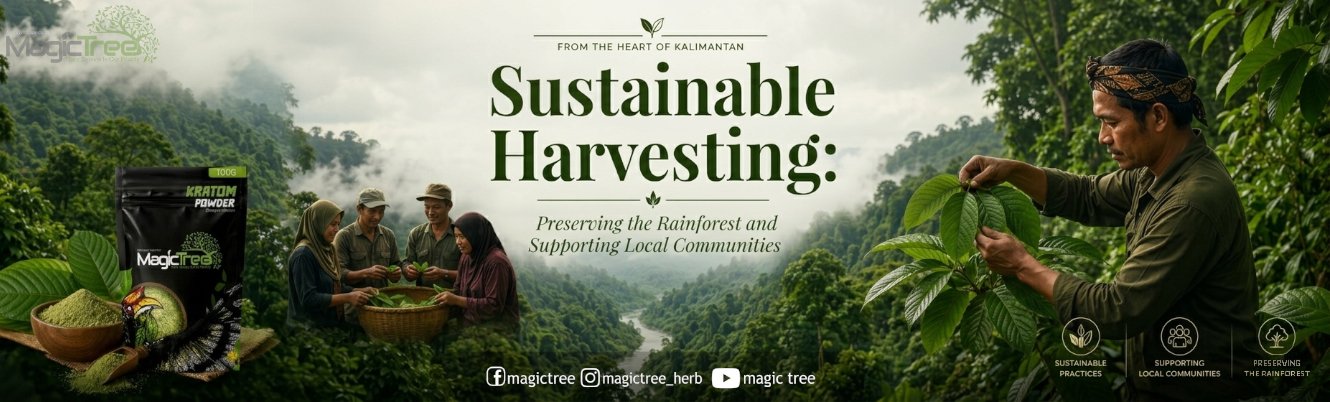
The dense, emerald canopies of the world’s rainforests, particularly in regions like Kalimantan, are often referred to as the “lungs of the earth.” Beyond their role in carbon sequestration, these ecosystems are treasure troves of biodiversity and home to millions of people who depend on the forest for their survival. As global demand for specialized botanical products—such as Mitragyna speciosa and other traditional herbs—surges, the balance between economic gain and environmental preservation has reached a critical tipping point.
Sustainable harvesting is no longer just a buzzword; it is a mechanical necessity for the survival of both the rainforest and the communities that guard it. By implementing ethical extraction methods, we can ensure that the forest remains a renewable resource rather than a disappearing one.
Understanding the Core of Sustainable Harvesting
Sustainable harvesting refers to the practice of collecting botanical resources in a way that does not deplete the species or damage the surrounding ecosystem. Unlike industrial clear-cutting, sustainable practices focus on selective extraction. This means only taking mature leaves or barks while allowing the tree to continue its natural growth cycle.
Read also : Why West Borneo (Kalimantan) Produces the World’s Highest Quality Kratom
For the wild-growth forests of Indonesia, this involves a deep understanding of seasonal cycles and the symbiotic relationships between plants and local wildlife. When we harvest responsibly—focusing on the alkaloid-rich leaves of mature trees—we preserve the “mother trees” and the soil integrity that allows the next generation of the forest to thrive.
Supporting Local Communities: The Human Element
At the heart of every sustainable forest is a thriving local community. Indigenous populations and local farmers are the primary stakeholders of the rainforest. For generations, they have lived in harmony with these lands, possessing traditional ecological knowledge (TEK) that modern science is only beginning to quantify.
- Economic Stability: Ethical sourcing provides a consistent income for local families. By establishing direct-trade partnerships, farmers receive a fair wage that reflects the intensive labor required for quality botanical processing.
- Preventing Illegal Logging: When local communities can earn a living through the sustainable harvest of non-timber forest products (NTFPs), they become the forest’s strongest protectors. Economic empowerment reduces the incentive for illegal land clearing.
- Preserving Heritage: Supporting local communities means protecting their way of life. Sustainable business models often fund local infrastructure, ensuring that the legacy of botanical wisdom is passed down to the next generation.
The Environmental Impact: Protecting Biodiversity
Rainforests house more than 50% of the world’s plant species. A single hectare can contain hundreds of unique trees, including various Mitragyna lineages. Sustainable harvesting protects this biodiversity through several key mechanisms:
- Canopy Integrity: By avoiding large-scale machinery, the forest canopy remains intact. This regulates the forest floor temperature and protects the habitats of arboreal species.
- Soil Health: Manual, traditional harvesting methods—often done by hand or with simple tools—keep the soil aerated and fertile, preventing the erosion that typically follows industrial logging.
- Water Cycle Regulation: Sustainable practices ensure that the forest continues to transpire moisture, preventing droughts in agricultural areas downstream and maintaining the humidity necessary for high-quality botanical growth.
The Role of Transparency and Traceability
In the modern global market, consumers are increasingly demanding to know the origin of their botanical supplements. This is where traceability becomes a pillar of sustainability. From the moment a leaf is hand-picked in the heart of Indonesia to the moment it reaches a consumer, every step should be documented.
Professional suppliers now utilize rigorous standards to prove that their products are harvested from sustainable wild-growth or organic plantations. This transparency ensures that “sustainable” isn’t just a label, but a verified fact of the supply chain that respects both the plant’s biology and the harvester’s effort.
Conclusion
Sustainable harvesting is the bridge between the modern economy and the ancient forest. It recognizes that we cannot protect the rainforest by walling it off; we must instead integrate it into a circular economy that values life—both plant and human—above short-term profit. By supporting products that prioritize “Preserving the Rainforest and Supporting Local Communities,” we are voting for a future where the emerald canopies of our planet continue to breathe for us all.