
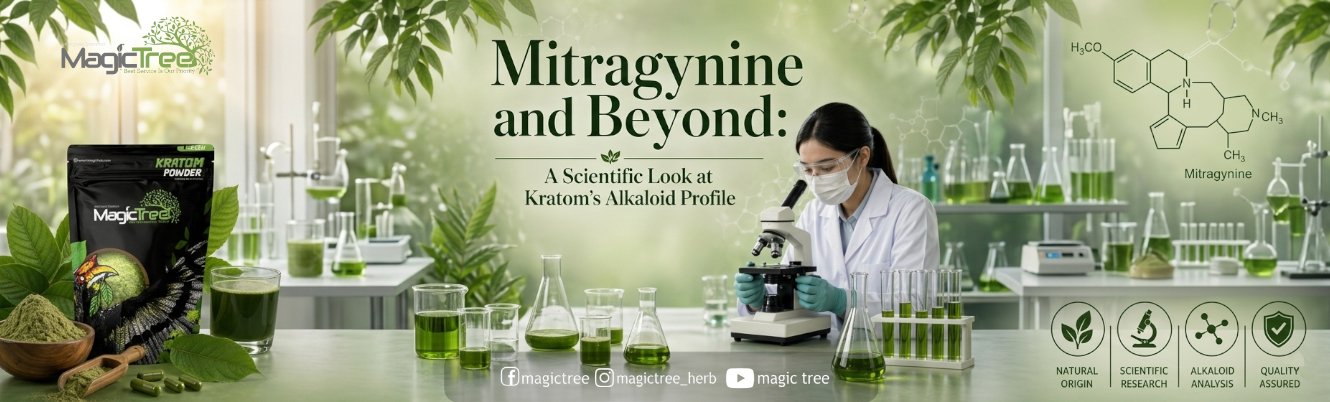
The botanical world is rich with complex chemistry, but few plants have garnered as much scientific interest recently as Mitragyna speciosa, commonly known as Kratom. Native to the lush tropical forests of Southeast Asia, this member of the Rubiaceae (coffee) family is more than just a traditional herb; it is a sophisticated chemical powerhouse.
To truly understand its potential, we must look past the leaves and dive into the microscopic world of alkaloids. Here is a scientific breakdown of the primary compounds that define Kratom’s unique profile.
The Power of Mitragynine: The Primary Alkaloid
Mitragynine is the most abundant alkaloid found in the Kratom leaf, often accounting for up to 60% of the total alkaloid content. From a molecular standpoint, it is classified as an indole alkaloid.
- The Mechanism: Unlike traditional opioids, mitragynine is considered a selective partial agonist of the mu-opioid receptors.
- Scientific Distinction: Research suggests that mitragynine acts as a “biased agonist,” meaning it may activate certain cellular pathways while avoiding others (such as the beta-arrestin pathway), which is a major area of study for researchers looking at respiratory safety.
- Energy and Focus: In lower concentrations, mitragynine is often associated with stimulating effects, which traditional workers in Southeast Asia have utilized for centuries to combat fatigue.
Read also : The Ultimate Guide to Importing Kratom Wholesale from Indonesia
7-Hydroxymitragynine: The Potent Minority
While mitragynine is the most prevalent, 7-hydroxymitragynine (7-OH) is perhaps the most pharmacologically active. Even though it exists in much smaller concentrations—usually less than 2% of the leaf’s makeup—its impact is significant.
- Oxidation Process: 7-OH is often formed through the oxidation of mitragynine. This process can occur during the drying and curing phases of the leaf.
- Potency: Scientific studies indicate that 7-OH has a high affinity for opioid receptors, making it a key player in the plant’s alkaloid synergy.
Beyond the Big Two: The Supporting Alkaloids
Kratom contains over 40 different alkaloids, many of which are still being mapped by modern science. These “minor” alkaloids play a crucial role in the “Entourage Effect,” where the combination of compounds produces a different result than any single isolated molecule.
| Alkaloid | Scientific Interest | Potential Role |
| Paynantheine | Second most abundant alkaloid | May act as a smooth muscle relaxant. |
| Speciogynine | Diastereomer of mitragynine | Studied for its potential effects on the gastrointestinal system. |
| Speciociliatine | Unique molecular structure | Currently being researched for its specific receptor binding affinity. |
| Corynantheidine | Opioid antagonist properties | May act as a natural “buffer” to the more potent alkaloids. |
Understanding the Variations: Why Strains Matter
The reason one batch of Kratom may differ from another lies in the alkaloid variability. Several factors influence the final chemical “fingerprint” of the plant:
- Geography: Soil composition in regions like West Kalimantan or Thailand changes the nutrient intake of the tree.
- Maturity: The age of the tree and the leaves at the time of harvest.
- Post-Harvest Processing: Whether the leaves are dried in the sun (UV exposure) or indoors significantly alters the conversion of mitragynine into 7-hydroxymitragynine.
The Importance of Lab Testing
For researchers, exporters, and consumers alike, COAs (Certificates of Analysis) are the gold standard. High-performance liquid chromatography (HPLC) is used to quantify these alkaloids, ensuring that the profile is consistent and free from contaminants.
As we move “beyond mitragynine,” the scientific community is beginning to appreciate Kratom not as a simple plant, but as a complex matrix of alkaloids that requires precise understanding and responsible handling.
Note: The study of Mitragyna speciosa is ongoing. Always ensure you are sourcing materials from suppliers who prioritize transparency, botanical education, and rigorous laboratory standards.