
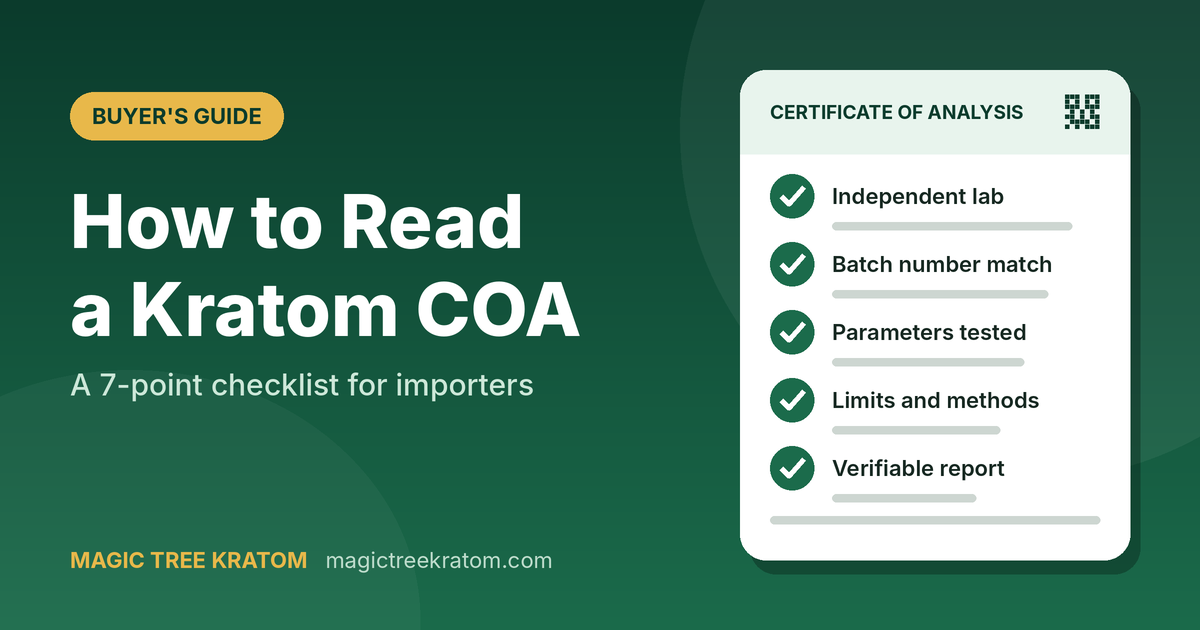
Learn how to read a kratom Certificate of Analysis (COA) before a bulk order. A practical checklist for importers, with what to verify on every report.
A kratom COA (Certificate of Analysis) is one of the most useful documents an importer can request from a kratom supplier. A report only protects your business if you know what it covers and whether it actually belongs to the product you are buying.
This checklist walks through what to look for on a kratom COA, the questions to ask your supplier, and the warning signs that a report may not be as reliable as it looks.
What Is a Kratom COA and Why Does It Matter for Bulk Orders?
A COA is a report issued by a laboratory after testing a specific sample. It lists the parameters that were tested, the methods used, and the results. For bulk buyers it serves three purposes:
- It gives you objective data to compare against the specifications agreed in your purchase order.
- It helps you prepare the documentation your destination market may require. Requirements vary by country and should always be verified independently.
- It creates a record you can refer back to if a question ever comes up about a shipment.
A kratom COA describes a sample from a specific batch. It is not a general guarantee about every product a supplier sells, which is why the details below matter.
How to Read a Kratom COA Step by Step
1. Is the laboratory independent and identifiable?
Check the lab’s name, address, and contact details. A third-party laboratory is generally more credible than an in-house report because it has no commercial interest in the result. Ask whether the lab holds an accreditation such as ISO/IEC 17025, and look for the accreditation reference on the report.
At Magic Tree, our product samples are tested by Sentarum Laboratory in Pontianak, West Kalimantan, which issues numbered reports with a QR code for verification. Examples are available on our Lab Result page.
2. Does the report match your batch or lot number?
This is the most commonly missed check. The batch or lot number on the COA should match the number on the product label and the shipping documents. If the report has no batch number, or a number that does not correspond to your shipment, it cannot be tied to what you receive.
3. Is the date recent and the sample clearly described?
Look at the sampling date, the testing date, and the report date. Very old reports may not reflect the current batch. The sample description should name the product (for example, kratom leaf powder) so there is no doubt about what was tested.
4. What parameters were actually tested?
Not every COA covers the same tests. Depending on the supplier, the buyer’s requirements, and the destination market, a report may include some or all of the following:
| Parameter | Why buyers look at it |
|---|---|
| Heavy metals (lead, cadmium, arsenic, mercury) | Safety and market compliance |
| Microbiological testing (total plate count, yeast and mold, Salmonella, E. coli) | Hygiene and safe handling |
| Pesticide residues | Required by some markets for plant products |
| Mycotoxins | Storage and handling quality |
| Alkaloid content | Product characterization and batch consistency |
| Moisture content | Storage stability and shipping quality |
Do not assume a missing test means the product failed. It may simply not have been requested. Tell your supplier in advance which parameters you need, then confirm they appear on the report.
Our current laboratory reports cover mitragynine content measured by HPLC. If your destination market requires additional tests, such as heavy metals, microbiological testing, or moisture content, please tell us before ordering so we can discuss what testing can be arranged.
5. Are the limits and methods stated?
A useful COA shows the result, the unit of measurement, the specification or limit, and the test method. A result printed without a limit tells you very little, because you cannot tell whether it is acceptable. If limits are missing, ask which standard they refer to and compare them with the requirements of your destination market.
6. Does “pass” mean what you think it means?
A “pass” is only meaningful against a defined standard. Ask which standard was used. A report that passes against one market’s limits may not satisfy another market’s requirements, so treat the COA as one input into your own compliance review rather than a replacement for it.
7. Can the document be verified?
Check for a signature or stamp, a unique report number, and contact details for the lab. A QR code can also help confirm authenticity. Many buyers contact the laboratory directly to confirm that the report is genuine. A reputable supplier will not object to this.
Red Flags to Watch For
- No batch or lot number on the report
- A laboratory name or address that cannot be found or verified
- Results with no limits, units, or methods
- Reports that look edited, cropped, or inconsistent in formatting
- A single COA offered for every product and every order
- Reluctance to explain how testing is done or to let you contact the lab
None of these automatically means a supplier is dishonest, but each is a reason to ask more questions before you place a bulk order.
Questions to Ask Your Supplier
- Which laboratory tests your products, and is it independent?
- Which parameters are tested, and how often?
- Is testing done per batch, and will my shipment come with its own COA?
- Can the COA be matched to the lot number on my packaging?
- Which limits or standards do you test against?
- Can I request a sample, or arrange independent testing at my own expense?
Put the agreed answers into your purchase agreement or specification sheet. When you know how to read a kratom COA, you can document testing expectations before the order is prepared, the same principle we covered in our guide to kratom product specifications.
A Quick Note on Regulations
Testing and labeling requirements differ widely between countries, and in some countries between regions. A COA is evidence of what was tested, not proof that a product can be legally imported or sold in your market. Always confirm import rules, labeling, and documentation requirements with the relevant authorities or a qualified customs adviser before ordering.
Conclusion
Reading a kratom COA well comes down to a few habits: confirm the lab is real, match the batch number to your shipment, check which parameters were tested, and compare results with clear limits. Buyers who do this consistently are better placed to build reliable, long-term supply relationships.
At Magic Tree Kratom, we provide laboratory reports for our products and are happy to discuss the testing your market requires. You can view examples on our Lab Result page, or contact our team to discuss your requirements for a bulk or wholesale order.