
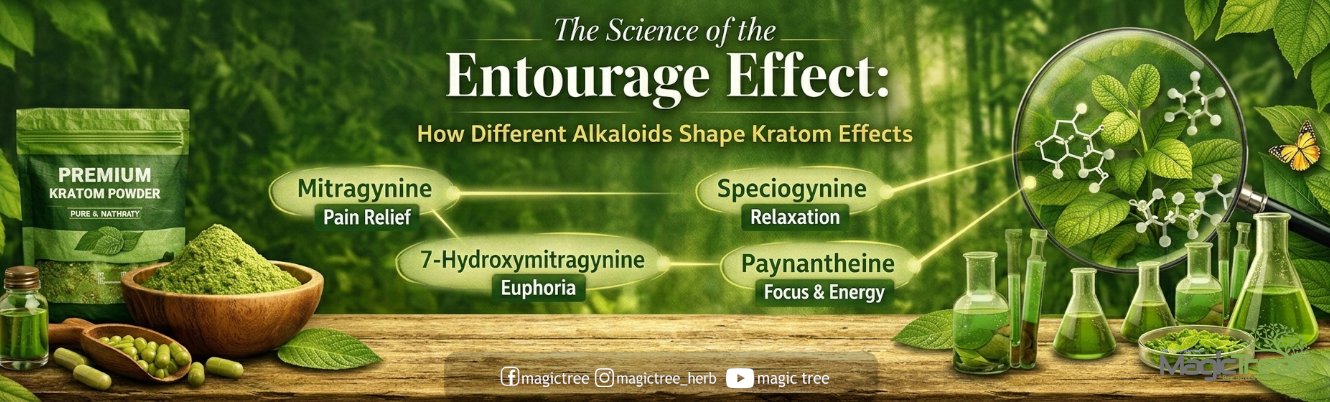
When you dive into the world of botanical supplements, you’ll likely encounter a fascinating concept known as the science of the entourage effect. While this term is often linked to other plants, it is the secret sauce behind why Kratom feels so balanced and multi-faceted. Instead of being a one-note botanical, Kratom acts more like a complex orchestra.
Many users make the mistake of looking only at the “potency” of a single compound. However, understanding the science of the entourage effect reveals that the “minor” players in the leaf are just as important as the stars. Let’s break down how these chemical relationships work and why the whole plant is better than its isolated parts.
What is the Entourage Effect in Kratom?
To put it simply, the entourage effect is a biological phenomenon where different compounds within a plant work together to produce a result that is greater than the sum of its parts. In the context of Mitragyna speciosa, this means that the 40+ alkaloids present in the leaf don’t just exist side-by-side; they interact, modulate, and enhance one another.
In the science of the entourage effect, a secondary alkaloid might “smooth out” the side effects of a primary one, or it might help the body absorb the main compounds more efficiently. This is why many enthusiasts prefer “Full Spectrum” products over highly processed isolates.
The Stars of the Show: Mitragynine and 7-Hydroxymitragynine
Before we look at the supporting cast, we must acknowledge the two primary alkaloids that define Kratom’s profile:
- Mitragynine: This is the most abundant alkaloid, often comprising up to 60% of the total alkaloid content. It is primarily responsible for the energizing and focus-enhancing effects associated with lower servings.
- 7-Hydroxymitragynine (7-OH): Though it appears in much smaller concentrations, it is significantly more potent. It provides the soothing, relaxing, and discomfort-relieving qualities that Kratom is famous for.
Without the other alkaloids, these two can sometimes feel “incomplete.” This is where the magic of synergy begins.
Exploring the Supporting Alkaloids
A deep dive into the science of the entourage effect shows us that the “minor” alkaloids act as the conductors of the symphony. Here are the key players shaping your experience:
1. Speciogynine and Speciociliatine
These are structural isomers of mitragynine. While they don’t get much press, recent studies suggest they contribute significantly to muscle relaxation. They help balance the stimulation of mitragynine, preventing the “jittery” feeling sometimes associated with caffeine.
2. Paynantheine
Often the second most abundant alkaloid in the plant, Paynantheine acts as a smooth muscle relaxant. It plays a crucial role in the physical “body feel” of Kratom, making the transition between energy and relaxation much smoother.
3. Corynantheidine
This alkaloid is a fascinating safety valve. It acts as a weak antagonist, meaning it can actually block certain receptors. This is part of why Kratom has a “ceiling effect,” preventing the primary alkaloids from overwhelming the system and making it inherently different from synthetic alternatives.
How Alkaloid Synergy Shapes Strain Colors
The reason a Red Maeng Da feels different from a White Borneo is rooted in the science of the entourage effect. Environmental factors, soil composition, and post-harvest processing (like fermentation) change the alkaloid ratios.
- White Vein Synergy: High in Mitragynine, low in 7-OH. The “entourage” here promotes adrenaline and dopamine-like focus.
- Red Vein Synergy: Higher levels of 7-OH and oxidized alkaloids. The “entourage” here shifts toward the parasympathetic nervous system, aiding sleep and comfort.
- Green Vein Synergy: A diverse, balanced profile of all 40+ alkaloids, providing a “hybrid” experience that many find perfect for daytime use.
Why Full-Spectrum is King
In the quest for “stronger” products, some manufacturers create pure Mitragynine extracts. While potent, these often lack the nuance of the natural leaf. The science of the entourage effect teaches us that by removing the “minor” alkaloids, you lose the natural buffers that prevent side effects like nausea or over-stimulation.
Read Also: HHS Policy Update: The Future of 7-OH Distribution in the U.S.
Using full-spectrum powders or extracts ensures that you are getting the plant’s chemistry exactly as nature intended—balanced, effective, and multi-layered.
The Future of Kratom Chemistry
As research continues, we are finding that Kratom’s alkaloids also interact with serotonin and post-adrenergic receptors. This means the entourage effect isn’t just about “pain” or “energy”—it’s about a holistic influence on your mood and well-being. Understanding the science of the entourage effect is the key to responsible and effective Kratom use.
Final Thoughts
Kratom is more than just a source of Mitragynine; it is a complex botanical matrix. By respecting the synergy between different alkaloids, you can better choose the right strain for your needs. Nature spent thousands of years perfecting this chemical balance—there’s a reason the “entourage” is invited to the party.